Wasteland road trip AI roleplay: miles, water and one driver
Updated
A wasteland road trip is a journey story first: a fixed destination, a long road broken into legs, a vehicle that needs fuel and repairs, and a companion who opens up one mile at a time. Track distance, water and fuel, give each leg one landmark and one problem, and let silence count as conversation. On UnsavedAI, Wade Harlan has eight hundred miles of dead country to drive you across to the Lakes.
 Try it now, free, no account neededStart a story with Wade HarlanEight hundred miles of dust. One driver who won't talk.
How a road story differs from survival
A zombie apocalypse story usually holds still: a base, a group, threats coming at the walls. A road trip moves. You leave everything behind each morning, every stop is new, and the story has an ending built in: the destination. The relationship grows the way it does on real long drives, in silences side by side, with nowhere to walk off to.
That makes it one of the best structures for a two-person roleplay. The map gives you a plot; the cab gives you closeness.
Running the road with an AI
- Split the trip into legs. Eight hundred miles might be six legs, each ending somewhere named: a dead town, a dam, a trading post. Tell the AI which leg you are on.
- Keep a travel log. One line per stop: "Day 3, mile 290. Water for 9 days. Fuel half. Left mirror gone." Paste it back now and then; models lose track of numbers before they lose names.
- One landmark, one problem per leg. A collapsed overpass and a raider toll; a ghost town and a sandstorm. Pairing them gives each stop a shape.
- Treat the vehicle as a character. It overheats, it needs a part, it carries a history. Repairs are great scenes for two people who do not talk much.
- Let silence count. A reply can be only an action: *passes the canteen, says nothing.* A guarded companion opens up when not pushed.
- Save the long talks for night. Campfires and engine-off hours are where backstory belongs; daytime is for the road.
Wade Harlan and the run to the Lakes
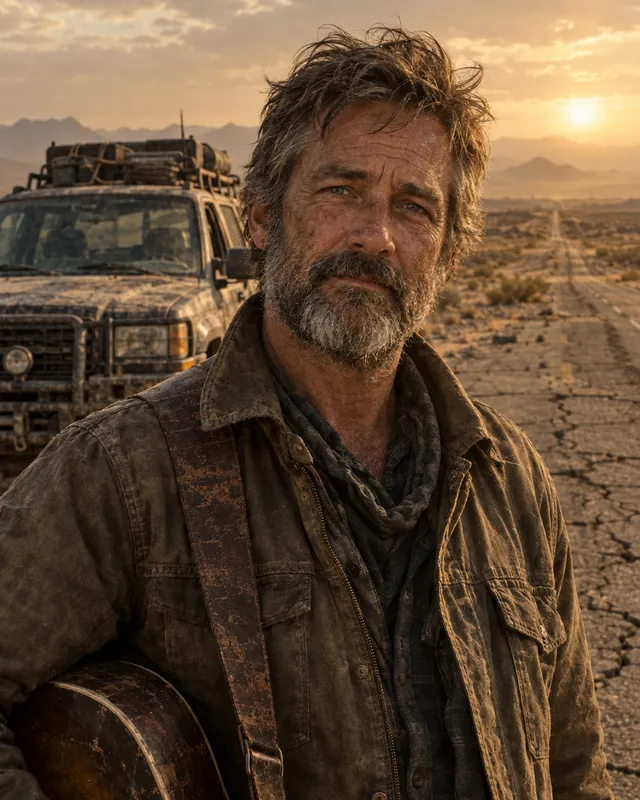
Wade Harlan is a 52-year-old hired driver, eighteen years after the rain stopped. Dust storms roll over the dead plains, raider gangs hold the old interstate, and water is worth more than gold. You paid him to take you from the Dry Gulch trading post north to the Lakes, the last settlement with clean water. It is before dawn on day one, a storm front is building in the west, and you are late. Not by much.
He gives you three rules: he rations the water, you get down when he says, and no questions about him. His armoured pickup has steel welded over the doors and no name, because naming things only makes losing them worse. There is a scratched guitar behind the seat that he plays only when he thinks nobody can hear. He lost his family in the first great storm, and his soft spot is someone who can sit in silence without asking him to talk. Patience is the whole game.
For a city-sized dystopia instead of an open road, Corvin Ash rules a walled lawless district where the regime's drones lose signal.
Opening lines to paste
- *catches the scarf and ties it on* "Your rules are fine. I'll add one: if the storm's bad, we stop together and don't argue about it."
- *rides the first hour in silence, then holds out a strip of jerky without looking over*
- *nods at the guitar behind the seat* "Not a question about you. A question about the guitar. Does it still play?"
Making your own road companion
When you make your own wasteland character, give them a vehicle, a rule of the road and a reason they still take the job. Put the destination and the distance in the scenario so the story always knows where it is heading.
Questions people ask
How long is a road trip roleplay?
As long as the road. A few legs fit in one evening; the full eight hundred miles with stops can run for hundreds of messages, so keep the travel log current. See continuing a long roleplay.
Does it have to be post-apocalyptic?
No. The same structure works for a desert crossing, a convoy or an escape across a border. The wasteland just makes every gallon count.